- Chemistry
- No Comments
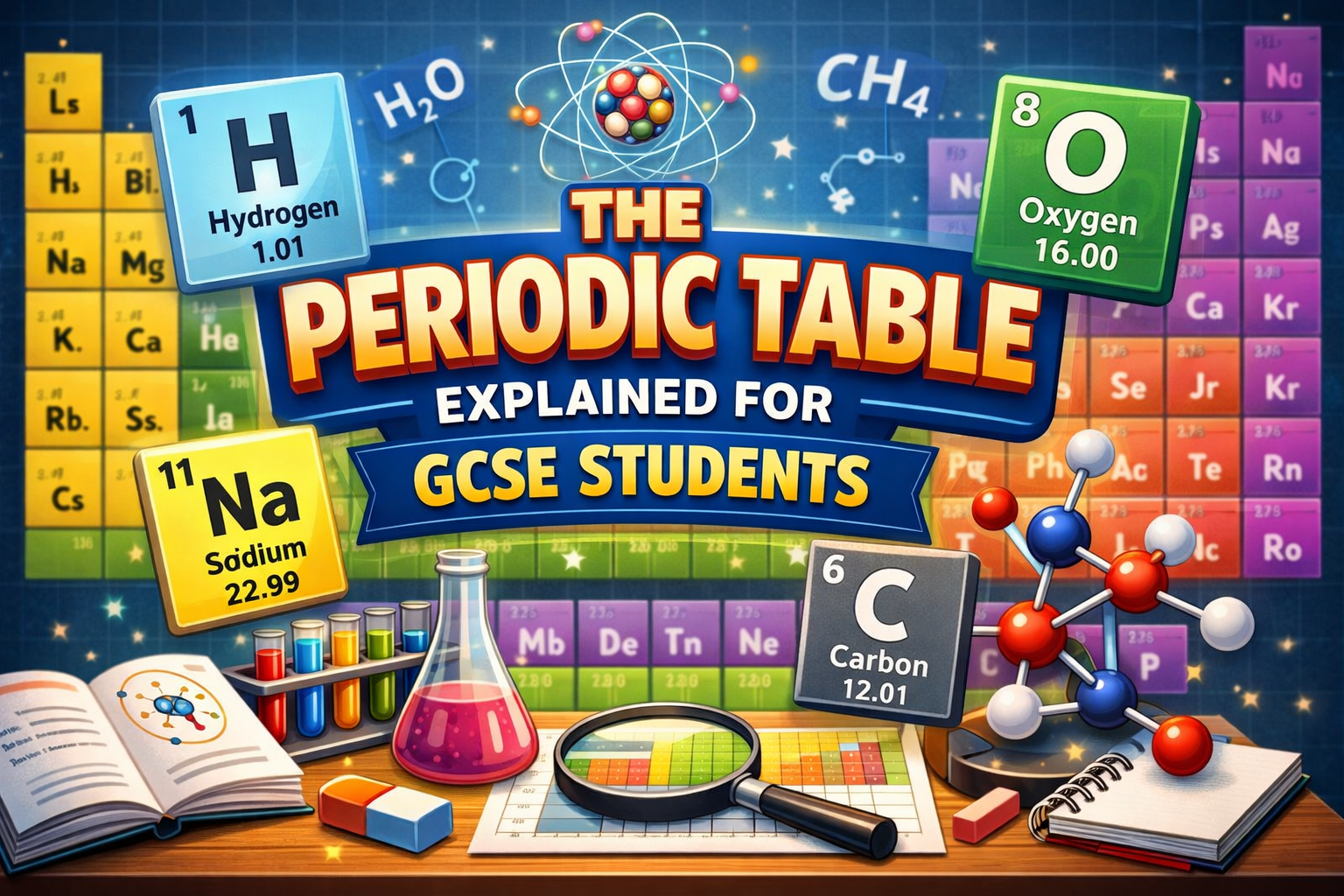
The periodic table is a roadmap of chemical behaviour, and understanding it can make GCSE Chemistry far easier. This guide explores groups, periods, atomic numbers, and trends, helping students recognise patterns that frequently appear in exams. By learning why elements react in certain ways, students can answer questions more accurately and deepen their understanding of core chemistry concepts.
The Periodic Table Explained for GCSE Students
The periodic table organizes all known elements by increasing atomic (proton) number, arranging them in vertical columns (groups) and horizontal rows (periods). Elements in the same group have similar properties due to having the same number of outer-shell electrons. Metals are on the left, non-metals on the right, separated by a staircase.
But before we delve into detailed explanation of the periodic table, let us consider some brief important key points:
History of the Periodic Table
Dmitri Mendeleev (1869): Organized elements by atomic weight, leaving gaps for undiscovered elements and switching elements to fit their properties.
Modern Table: Differs from Mendeleev’s by ordering elements by atomic number (number of protons) rather than atomic weight, which resolves issues with isotopes.
Core Structure and Definitions
- Groups (Columns): Vertical columns, numbered 1 to 7 and Group 0 (Noble Gases). Elements in the same group have the same number of electrons in their outer shell (valence electrons), leading to similar chemical properties.
- Periods (Rows): Horizontal rows that indicate the number of electron shells an atom possesses.
- Atomic Number: Ordered from left to right, this represents the number of protons in the nucleus.
- Atomic Mass: The weighted average mass of an element’s isotopes, usually shown as the top/larger number.
Key Groups for GCSE
- Group 1 (Alkali Metals): Very reactive metals, reactivity increases down the group.
- Group 7 (Halogens): Very reactive non-metals, reactivity decreases down the group.
- Group 0 (Noble Gases): Non-reactive, stable gases due to a full outer shell.
- Transition Metals: A block of metals located between Group 2 and 3 that form colored compounds.
Key Trends
- Reactivity: In Group 1, it increases downwards. In Group 7, it decreases downwards.
- Metallic Character: Increases going down a group and from right to left across a period.
Metals vs. Non-Metals
- Metals: Located to the left of the zigzag line. They are generally shiny, malleable, and good conductors.
- Non-metals: Located to the right of the zigzag line. They are typically dull, brittle, and poor conductors.
Now, let us delve into the content.
The periodic table is crucial for GCSE Chemistry. It organises elements by atomic number and gives insight into their properties and interactions. In this article, we’ll explain the periodic table’s structure and the importance of groups and periods within it. Practical tips will help you use the table and quiz questions are provided to test your understanding.
What is the Periodic Table?
The periodic table is a chart that shows all the elements. They are organised based on their atomic number, which is the number of protons in an atom’s nucleus. Having the elements presented in this way shows us how different elements interact, create compounds and behave in different chemical reactions.
The layout of the Periodic Table
The elements are divided into columns called groups and rows called periods. The position of each element in the table helps us understand its properties and behaviour:
- Groups: Elements in the same group or column have the same number of electrons in their outermost shell. This means they have similar chemical properties. For example, Lithium and Sodium are both in group 1 and are highly reactive metals (see Li and Na).
- Periods: Elements in the same period or row have the same number of electron shells. The properties of elements change as you move through the same period. For example, Lithium and Neon are at different ends of period 2 and have different chemical properties because of their electronic configurations (see Li and Ne).
Groups and Periods in the Periodic Table
The groups and periods within the periodic table are crucial to understanding the chemical behaviour of elements and their compounds. We have explored these below in more detail. As a quick reminder, groups are columns and periods are rows in the table.
Groups
There are 18 vertical groups in the periodic table. Every element belonging to the same group shares the same number of valence electrons. This leads to similar chemical properties. For example, the alkali metals in group 1 include Lithium, Sodium and Potassium. These elements are highly reactive and create strong bases when they combine with water.
Each group has its unique characteristics:
- Group 1 (Alkali Metals): Highly reactive metals. They are soft and have low melting points.
- Group 17 (Halogens): Very reactive nonmetals. They create salts when combined with metals.
- Group 18 (Noble Gases): Inert gases that are very stable. They will rarely create compounds because of their full valence electron shells.
Periods
There are 7 horizontal periods in the periodic table. The number of each period says the number of electron shells in the atoms of elements. For example, all elements in period 2 have two electron shells.
The atomic number increases as you move from left to right across the table. Elements also change from metals on the left to nonmetals on the right. This transition reflects the filling of electron shells and the increasing attraction between the nucleus and electrons.

Ready to put this into practice?
Engaging AI-powered lessons, interactive quizzes, and weekly coaching designed to help UK students master their subjects and succeed in exams.
Periods
There are 7 horizontal periods in the periodic table. The number of each period says the number of electron shells in the atoms of elements. For example, all elements in period 2 have two electron shells.
The atomic number increases as you move from left to right across the table. Elements also change from metals on the left to nonmetals on the right. This transition reflects the filling of electron shells and the increasing attraction between the nucleus and electrons.
Using the Periodic Table in Exams
You need to be able to apply your understanding of the periodic table in your GCSE exams. It’s far more important to understand its structure and how to extract information from the table than trying to memorise it in its entirety.
Key tips for exams
- Find the element groups: Get used to the key groups. This includes Alkali metals (group 1), Halogens (group 17) and Noble gases (group 18). This understanding will help you predict the behaviour of elements and their reactions to other elements.
- Understand electron configurations: Work out the number of valence electrons in an element using the table. This shows how elements bond and react with each other e.g. elements in group 1 have one valence electron and are very reactive.
- Practice with periodic trends: Memorise the trends across periods and down groups. This includes electronegativity, atomic radius and ionisation energy. Understanding the trends will let you predict the properties of unknown elements based on their position in the periodic table.
Example exam questions
- Find the elements: You may be asked to identify elements based on their position or properties.
- Predict reactions: Use the periodic table to predict how certain elements will react with others.
- Calculate molar mass: A common question is to calculate the molar mass of compounds by finding the atomic masses of elements.
Common mistakes about the Periodic Table
It’s easy to make mistakes when learning about the periodic table. It’s best to get ahead of these misunderstandings early to help you develop an accurate understanding of this tool in Chemistry.
The Periodic Table needs to be memorised
You don’t need to memorise the periodic table. It certainly wouldn’t hurt but you shouldn’t place this expectation on yourself as it isn’t required. It’s far more important to understand the table structure, how to apply it in exams and the importance of groups and periods within the table.
All elements in a group are identical
It’s true that elements in the same group have similar chemical properties because they have the same number of valence electrons. However, this certainly doesn’t make them identical. For example, Lithium, Sodium and Potassium are in group 1. While they are all alkali metals, they have different reactivity and physical properties because of their unique atomic structures.
The Periodic Table doesn’t change
A fact is only our latest understanding of a topic. For instance, Pluto was reclassified as a dwarf planet in 2006. In the same way, the periodic table is not fixed and continues to evolve as new elements are discovered. The elements Nihonium and Tennessine were only added to the table recently as our understanding of atomic theory continues to develop.
Practical tips for GCSE Periodic Table revision
We now have explored the structure of the periodic table. To use this tool effectively, we need effective study techniques:
Mnemonics and memory aids
Mnemonics are a great way to remember the order of elements and their groupings. You find mnemonics in all fields of education, such as learning to read music (e.g. “All Cows Eat Grass”).To remember the first 10 elements, a common rhyme is “Happy Henry Likes Beans But Can Not Obtain Food, Needing Nothing”. This stands for Hydrogen, Helium, Lithium, Beryllium, Boron, Carbon, Nitrogen, Oxygen, Fluorine and Neon.
Interactive resources
There is a wealth of online tools and periodic tables that you can interact with, such as Ptable. These dynamic visual aids often include quizzes and games to challenge your understanding and make revision far more engaging.
Use past papers
To replicate the type of questions you’ll get in an exam, you must use past exam papers. They will help familiarise you with a variety of chemistry questions on the period table. This resource is a must to reinforce your knowledge and improve your exam technique. To find past papers, look first at the resources provided by your exam board for GCSE Chemistry, such as AQA.
Group study sessions
Revision can be an isolating experience and you may find learning in a group to be a more stimulating and less stressful environment. Learning with others can also give different perspectives on complex topics and help reassure you of any doubts in your exam preparation.
Visual learning tools
Visual aids are a great way to help us remember complex information. Create charts and diagrams to show the periodic table’s structure, trends and element groups. Use different colours to show the distinctions and try recreating the modern periodic table from scratch if you’re up to the challenge.
Final thoughts: GCSE Chemistry Periodic Table
Share:
More Posts
How to Terminate Your Account
5 Ways to Master Algebra Fast For GCSE Exams