- No Comments
- Chemistry
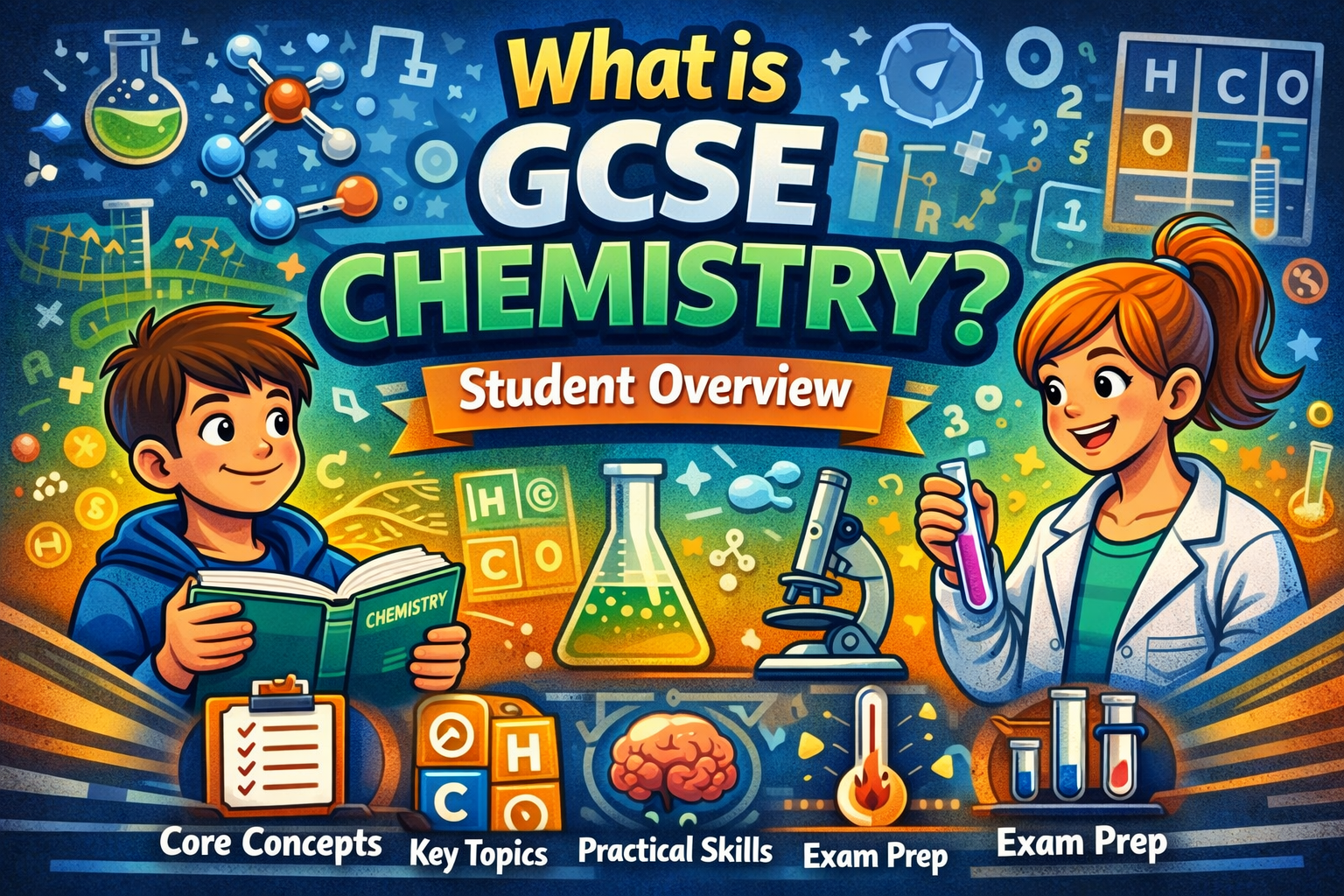
Science is a key part of the GCSE curriculum. Subjects like GCSE Physics and GCSE Chemistry help students understand the world around them, from the laws of motion to the structure of atoms. In this guide, we’ll focus on GCSE Chemistry, a subject that offers a fascinating look into matter at the molecular level.
What is GCSE Chemistry? Student Overview
Navigating the world of GCSE Chemistry can often feel like trying to solve a complex equation. With its intricate concepts, mathematical applications, and practical assessments, it’s no wonder many students find it challenging. But fear not, parents.
This comprehensive guide is here to demystify GCSE Chemistry, from understanding the grading scheme to mastering key topics. We’ll delve into common difficulties students face, provide sample exam questions with detailed explanations, and even explore the benefits of online tutoring.
So, whether you’re looking for effective revision resources or insights into the marking scheme, this article is your one-stop solution to support your child’s GCSE Chemistry journey. Let’s turn those chemical conundrums into confident comprehension.
What is GCSE Chemistry?
GCSE Chemistry is the science of matter and how it transforms through chemical reactions. I often say it’s the science behind everyday things like baking a cake, firework displays amd taking medicine. It’s not just about reactions in a lab, it’s about the chemistry happening all around you.
You’ll study Chemistry either as part of Combined Science (also called Trilogy or Double Science) or as a standalone Triple Science. I’ve seen students flourish in both. Combined Science gives a well-balanced overview, while Triple Science lets you dive deeper into chemistry, perfect if you’re someone who has a real interest in science.
According to the (opens in a new tab) Joint Council for Qualifications, over 700,000 students take GCSE science subjects each year. This makes science one of the most popular qualification areas.
What topics will you study in GCSE Chemistry?
GCSE Chemistry covers a broad spectrum of topics, providing students with a comprehensive understanding of the world at a molecular level. Here are some of the key areas of study:
Atomic Structure and the Periodic Table
- Atomic Structure: This topic delves into the composition of atoms, including protons, neutrons, and electrons, and how they influence the properties of elements.
- The Periodic Table: Students learn about the arrangement of elements, periodic trends, and the significance of groups and periods.
Read more about the Periodic Table here.
Bonding, Structure, and the Properties of Matter
- Chemical Bonding: This section covers the different types of chemical bonds – ionic, covalent, and metallic – and how they determine the properties of substances.
- Structure of Matter: Students explore the different states of matter, changes of state, and the kinetic particle theory.
Quantitative Chemistry
- Moles and Equations: This topic introduces the concept of the mole, a fundamental unit in chemistry, and its application in chemical equations.
- Concentration of Solutions: Students learn how to calculate the concentration of solutions and understand its impact on reactions.

Ready to put this into practice?
Engaging AI-powered lessons, interactive quizzes, and weekly coaching designed to help UK students master their subjects and succeed in exams.
Chemical Changes and Energy Changes
- Reactions and Energy Changes: This section covers various types of chemical reactions, such as oxidation and reduction, and the associated energy changes.
- Electrolysis: Students learn about the process of electrolysis, its applications, and its role in the extraction of metals.
Organic Chemistry
- Hydrocarbons: This topic introduces students to organic chemistry, starting with the study of hydrocarbons – compounds of hydrogen and carbon.
- Alcohols and Carboxylic Acids: Students learn about the properties and reactions of other organic compounds, including alcohols and carboxylic acids.
Others include: Chemical analysis – learning how scientists identify unknown substances and test for purity; and Chemistry of the atmosphere – understanding our planet’s atmosphere and environmental issues like climate change.
Each of these topics contributes to a well-rounded understanding of chemistry, equipping students with the knowledge and skills they need for further study in the field.
Common Challenges in GCSE Chemistry
GCSE Chemistry, while fascinating, can pose certain challenges for students. Understanding these can help parents provide the right support. Here are some common difficulties:
Understanding Complex Concepts
Chemistry is a subject that requires students to grasp abstract concepts, such as atomic structure or chemical bonding. These can be challenging to visualise and understand, unlike GCSE Biology which often deals with more tangible systems that students can observe in daily life.
Applying Mathematical Skills
Chemistry isn’t just about memorising facts; it’s also about applying mathematical skills. Balancing chemical equations or calculating moles can be difficult for those who struggle with maths.
Practical Laboratory Work
Practical work is a key component of GCSE Chemistry. However, translating theoretical knowledge into practical skills in a lab setting can be a hurdle for some students.
Time Management in Exams
Chemistry exams often require students to solve complex problems under time pressure. This can be challenging, particularly when it comes to longer, multi-step questions.
Remembering Terminology
Chemistry comes with its own language. Remembering and correctly using scientific terminology can be a stumbling block for many students.
By understanding these challenges, parents can better support their children in overcoming them, whether through additional practice, tutoring, or finding effective revision resources.
Sample GCSE Chemistry Exam Questions
Atomic Structure and the Periodic Table
The atomic number is 7 and the mass number is 14.
- Common Mistake: Confusing the atomic number with the mass number. The atomic number is the number of protons in an atom, while the mass number is the sum of protons and neutrons.
- Explanation: In this case, the element with an atomic number of 7 is Nitrogen. The mass number is calculated by adding the number of protons (7) to the number of neutrons (7), giving us 14.
Bonding, Structure, and the Properties of Matter
Sodium chloride conducts electricity when molten because its ions are free to move and carry charge.
- Common Mistake: Stating that sodium chloride doesn’t conduct electricity at all. It doesn’t conduct in solid state because the ions are not free to move.
- Explanation: In the solid state, the ions in sodium chloride are held in a lattice structure and cannot move. When molten, the lattice breaks down, and the ions can move and carry charge, allowing the substance to conduct electricity.
Quantitative Chemistry
0.1 moles of hydrogen gas will be produced.
- Common Mistake: Misunderstanding the mole ratio in the balanced equation. The ratio is 1:1 for Mg to H2, not 1:2.
- Explanation: From the balanced equation, we can see that one mole of magnesium reacts with two moles of hydrochloric acid to produce one mole of hydrogen gas. So, if 0.2 moles of magnesium are reacted, 0.2 moles of hydrogen gas will be produced.
Chemical Changes and Energy Changes
The student would observe the anode gradually diminishing or dissolving. This happens because copper atoms at the anode lose electrons to form copper ions, which go into the solution.
- Common Mistake: Stating that nothing happens at the anode or that the anode gains mass. The anode actually loses mass as copper atoms are oxidised and move into the solution.
- Explanation: During electrolysis, oxidation occurs at the anode. In this case, copper atoms at the anode are oxidised to copper ions, which enter the solution, causing the anode to gradually diminish.
Organic Chemistry
The balanced symbol equation is C2H5OH(l) + O2(g) -> CH3COOH(l) + H2O(l).
- Common Mistake: Forgetting to balance the equation or include state symbols. Both are important for a complete and correct answer.
- Explanation: Ethanol (C2H5OH) reacts with oxygen (O2) to produce ethanoic acid (CH3COOH) and water (H2O). The state symbols are (l) for liquid and (g) for gas.
Effective Revision Resources for GCSE Chemistry
To support your child’s GCSE Chemistry revision, a variety of resources are available. These can help reinforce their understanding, provide additional practice, and build their confidence. Here are some effective resources:
Textbooks
The GCSE Chemistry textbook from the exam board is an essential resource. It covers all the topics in the syllabus, often with practice questions and detailed explanations.
Revision Guides
These provide condensed notes on key topics, making them a great tool for quick revision. Look for guides that are specific to your child’s exam board.
Past Papers
GCSE Chemistry past papers are invaluable for understanding the exam format, practising under timed conditions, and getting used to the style of questions.
Online Tutoring
Online tutoring, like Enrichment Lessons, can provide personalised support tailored to your child’s needs. It can help clarify difficult concepts, provide additional practice, and boost confidence.
Remember, the most effective revision involves a mix of resources. Encourage your child to try different methods and find what works best for them.
The Benefits of GCSE Chemistry Tuition
GCSE Chemistry tuition can provide a significant boost to a student’s understanding, confidence, and ultimately, their exam performance. Here are some of the key benefits:
Personalised Learning
A tutor can tailor lessons to your child’s specific needs, focusing on areas they find challenging and reinforcing concepts they’ve learned in school. This personalised approach can make learning more effective and enjoyable.
Subject-Specific Expertise
A Chemistry tutor brings a deep understanding of the subject. They can explain complex concepts in a clear, accessible way, provide insights that go beyond the textbook, and share effective strategies for tackling exam questions.
Regular Feedback
Tutors provide regular, constructive feedback, helping students understand their strengths and areas for improvement. This can help them make consistent progress and avoid common mistakes.
Improved Confidence
With a tutor’s support, students can gain a deeper understanding of Chemistry, which can significantly boost their confidence. This can lead to improved performance in exams and a more positive attitude towards learning.
Flexibility and Convenience
Online tuition offers the flexibility to learn from anywhere, saving travel time and making it easier to fit lessons around your child’s schedule. It also allows for a wider choice of tutors, as you’re not limited to those in your local area.
Access to Additional Resources
Many online tutors provide a range of additional resources, such as revision notes, practice questions, and interactive learning tools. These can supplement your child’s revision and help them prepare more effectively for their exams.
Conclusion
As we navigate the intricate world of GCSE Chemistry, it’s clear that the journey, while challenging, is also a fascinating exploration of the universe at a molecular level. It’s a journey that not only equips students with a solid foundation for further studies in science but also fosters critical thinking, problem-solving, and a sense of curiosity – skills that are invaluable in any future endeavour.
Yet, every journey is easier with a guide, someone who has walked the path before and can provide support, insights, and encouragement along the way. This is where ‘Enrichment Lessons’ comes in. More than just an online tutoring platform, Enrichment Lessons is a community of mentors who are committed to helping students realise their potential.
The tutor at Enrichment Lessons is a student from a top UK university, bringing not only their academic expertise but also their personal experience of the challenges and triumphs of learning. They understand that every student’s journey is unique and are ready to provide personalised support tailored to their needs.
So, as we continue to support our children in their GCSE Chemistry journey, let’s remember that we’re not alone. With resources like Enrichment Lessons’ GCSE Chemistry tutor, we can provide them with the guidance, support, and inspiration they need to not just succeed, but truly excel. Because every atom of effort counts, and every molecule of knowledge matters.
Share:
More Posts
Cookie Policy
March 22, 2026
How to Terminate Your Account
March 21, 2026
5 Ways to Master Algebra Fast For GCSE Exams
March 19, 2026