- Mathematics
- No Comments
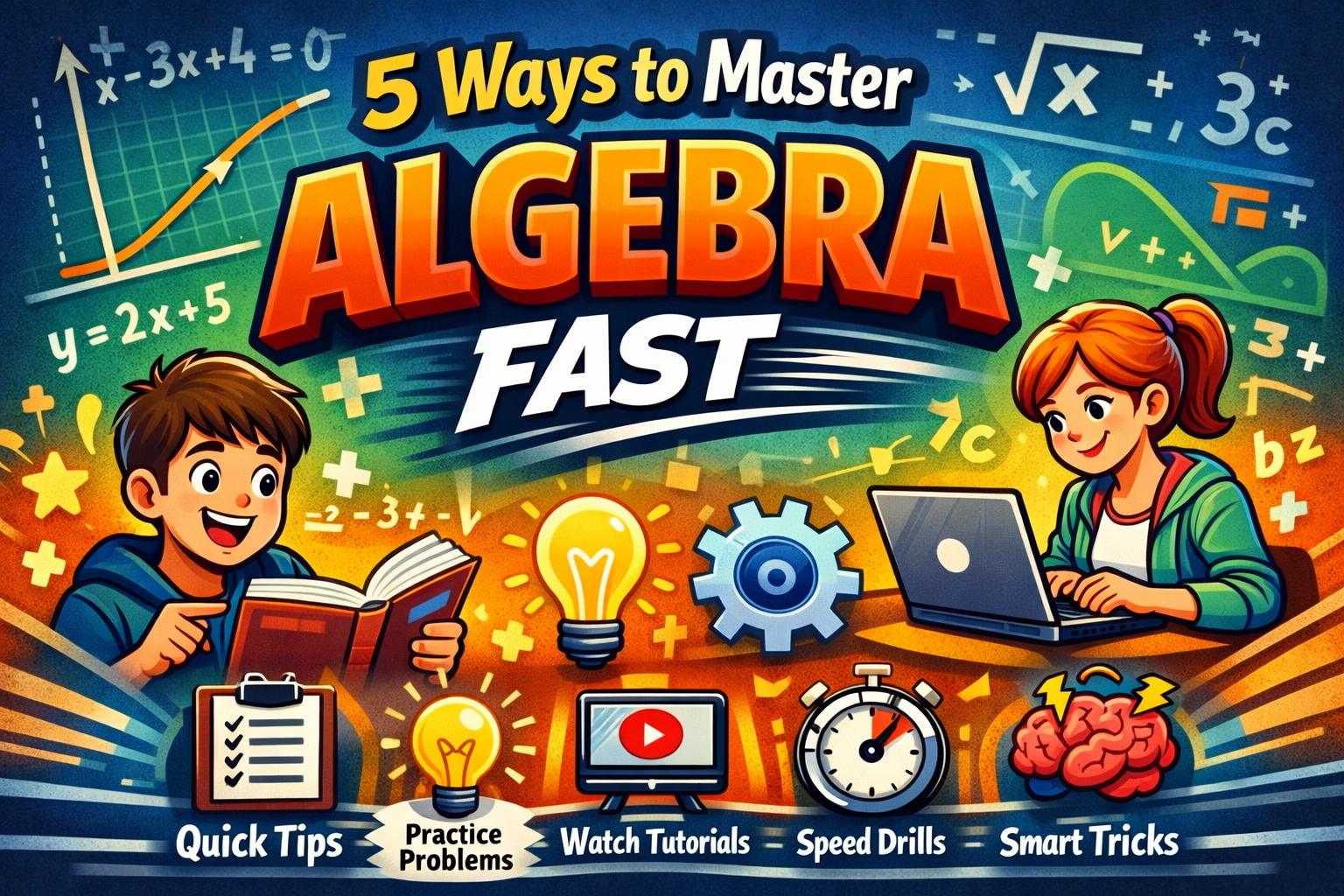
Mastering algebra for the GCSE exam in a short time requires a shift from passive reading to active, consistent practice. Focused techniques, such as prioritizing high-yield topics and understanding the “golden rule” of algebra, can significantly improve your speed and accuracy.
5 Ways to Master Algebra Fast For GCSE Exams
GCSE algebra is one of the most challenging Maths topics for GCSE students, especially when it comes to that daunting feeling of having to sit an exam! This not only means that revising for GCSE algebra can be very stressful for students, but for families and teachers too.
However, with a solid study schedule, support from family members, teachers, and helpful learning tools, students can feel confident when it comes to answering an algebra question.
What is Algebra?
Algebra is a branch of mathematics that uses letters and symbols to represent numbers and quantities in formulas and equations. Formulas and equations are used to describe relationships between things that vary over time.
With GCSE algebra, students will be asked to solve problems that require an understanding of:
- factorising
- travel graphs
- inequalities
- indices
- algebraic fractions
- simultaneous equations
- equation of a straight line
- quadratic equations
- functions
Importance of Algebra
Doing algebra homework is often tedious, but it will be useful in many ways aside from giving you a good grade in the subject.
Understanding why algebra is important in our lives to provide a new perspective on why it is crucial to implement in our curriculum even though you may not want to become an engineer.
1. Algebraic formulas can be applied in other areas
Algebraic formulas are not just used for class. It can also be used in other subjects and even in daily life. For example, if you want to know the area of a circle, you can use the algebraic formula for it. You can also apply the same formula on electric bills.
2. It can help you solve other math problems
Just like science, algebra can be applied in other branches of mathematics. Each formula is also interrelated so if you know one formula, it will make other math problems easier to solve.
3. Improves study skills
If you practice solving algebra through your homework, it will help you strengthen your math skills. Concepts will become familiar to you and you will find it easier to manage algebra problems. As you practice, you will be able to master each formula and pass your exams easily.
4. Improves memory
It is not uncommon to hear about students who forget things they learn in school, especially topics from difficult subjects. When they do algebra regularly, their memories will become sharper and perform well in exams. They can also recall formulas and theorems better.
5. Learn better research techniques
Some algebra problems may require extra research to get the right formula. Students will learn where they could find these formulas and discover what else algebra has to offer.
6. Algebra is everywhere
Believe it or not, a lot of careers require masters at algebra. Apart from the obvious jobs like math teacher and physicist, these jobs require algebra at work too:
• Architects
• Air traffic controllers
• Economists
• Purchasers
• Financial Planners
• Bankers
• Pilots
Ways to Master Algebra Fast For GCSE Exams
If you want to master algebra, there are many ways to do it quickly. Here are some of our tips to get you started:
Prepare formula and theorem sheets
Math involves a lot of formulas and it can be very confusing to memorize them all.
Write all the formulas for algebra in a sheet of paper and review it as you do your homework. You can also add in theorems to understand the formulas better.
Just make sure that while you study these formulas and theorems, you should also practice their applications. This will make the subject easy to understand and utilize.
Integers do not have the answers
Contrary to popular belief, algebra problems do not end with a round number. They usually come in irrational numbers, fractions or decimals.
A good way to get the right answers in algebra is by using an algebra calculator. You can also use algebra to simplify complex equations.
When answering the question, you can use scientific notation or factoring. If you think your answers are incorrect, seek the help of your teacher to double check your work.
Use PEMDAS

Ready to put this into practice?
Engaging AI-powered lessons, interactive quizzes, and weekly coaching designed to help UK students master their subjects and succeed in exams.
PEMDAS (Parenthesis, exponents, multiplication, division, addition and subtraction) is a good way to make algebra problems easy to solve.
Through this method, you can start answering the problems in the parenthesis then end with subtraction. Depending on what is given in the question, begin answering from the left before going to the right.
With this in mind, you can look at algebra as a jigsaw puzzle that needs to be solved through little pieces.
Use the FOIL method
When you are answering an algebra problem, it is ideal to use the FOIL method to solve binomials. FOIL (First, Outside, Inside, Last) will help you get the variables you need.
As you work on the problem and it asks you to either add or subtract, do the same on the other side. You should then combine similar variables to get the answers.
Get 1 to 1 coaching
If you want to get your algebra homework checked, you can ask your parents, siblings or a tutor to help you out. With their guidance, they can help you identify mistakes and guide you on how to correct them. They can even advise you on which techniques will make it easier for you to answer algebra.
After you finish your work, you can review the problem with your parent, sibling or tutor. You can also ask them to check your scores and see which algebra problems you find difficult to answer. Mock exams can also help you manage your time answering these questions.
As an alternative, you can also look into Maths tuition to perfect your algebra. Your tutor can help you review algebra formulas and theorems.
Algebraic vocabulary
What are the differences between an equation, a formula, an expression and an identity? Take a look at my simplified table to help.
| Example | What are they? | What can you do with them? | |
|---|---|---|---|
| Equation | 2x + 1 = 5 | A statement where the left-hand side and right-hand side are equal | Solve them to find x |
| Formula | y = mx + c | A worded rule, definition or relationship written in letters for shorthand | Substitute values into them |
| Expression | 2x + 1 | A collection of terms and numbers with no equals sign | Simplify, expand, factorise or rewrite them, e.g. x + x + 1 (you cannot solve them) |
| Identity | x + x + 1 ≡ 2x + 1 | A different way to write an expression that works for any value of x (it has a 3-line equals sign) | Rewrite expressions and equations in a different form (you cannot solve them) |
Common mistakes to avoid
The most common error I see is substituting negative numbers incorrectly into expressions.
For negative numbers, always use brackets followed by BIDMAS/BODMAS. For example:
Substitute x = -2 into 5x2
Correct: 5 × (-2)2 = 5 × 4 = 20
Incorrect: 5 × -22 = 5 × -4 = -20
Incorrect: (5×-2)2 = (-10)2 = 100
Incorrect: (5×-2)2 = -102 = -100
Beware: your calculator can confuse you! If you type -22 you get -4, but the square of -2 is positive 4, not negative 4. You need to type in the brackets, (-2)2, to get the correct answer.
Another common mistake is expanding brackets. For example:
Solve (x + 3)2
Correct: (x + 3)(x + 3) — expand using FOIL then collect like terms to get x2 + 6x + 9
Incorrect: x2 + 32 to get x2 + 9
I have seen a lot of students who know this common error still get quadratic simultaneous equations wrong, for example when substituting y = x + 3 into x2 + y2 = 9, and then squaring incorrectly!
Final Words
Algebra may sound like a tricky subject to master, but there are ways to get around these problems quickly and easily. Algebra has a lot of methods, theorems and formulas. It also has a lot of uses in other subjects and can be applied in real life.
When you get algebra homework, don’t ignore it immediately. Learn these tricks to master this complex subject today and see how fast you will be able to flourish in the subject.
You will also be able to appreciate the subject even if it is difficult to learn with these tricks. Good luck!
If you need personalised support in learning Algebrae, Enrichment Lessons has a verified GCSE Mathematics tutor, who is experienced with this topic and getting students through their examinations.
Share:
More Posts
Cookie Policy
March 22, 2026
How to Terminate Your Account
March 21, 2026
What is GCSE Chemistry? Student Overview
March 19, 2026